Brockway Road Can’t Support Additional Development
Most people who live in Sierra Meadows or the surrounding neighborhoods already know that Brockway Road can be painfully congested.
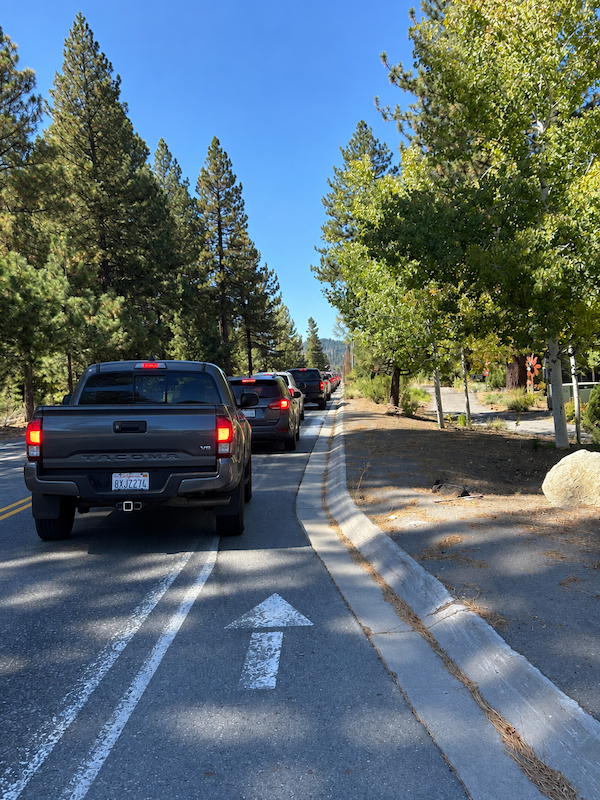
There are days when it can take ten minutes just to drive the one-mile stretch of road. Brockway Road is the primary connection between Highway 267 and downtown Truckee. It also serves as an important route between downtown and points west and Highway 267, the Truckee Bike Park and sports fields, the Soaring Way shopping center, and the businesses surrounding the airport.
During peak commute times, traffic can slow to a crawl. Entering the flow of traffic at the Martis Valley Road roundabout can be difficult, and crossing Brockway Road as a pedestrian or cyclist can be challenging.
Then there are the special events, when the situation can get considerably worse.
Here are a few examples:
- Tuesday mornings during Farmers Market season: Limited parking means people often park along Brockway Road and slow down while searching for an available space. During these periods, vehicles frequently occupy the bike lanes as well.
- Wednesday evenings during Music in the Park: The same basic problem occurs as large numbers of people make their way to this popular summer event.
- Thursday evenings during the summer: Traffic can crawl as visitors from North Tahoe travel down Highway 267 toward downtown Truckee.
- Truckee Rodeo weekend: This summer, traffic on Brockway Road reached the point of complete gridlock.
- Highway 267 and busy ski weekends: Whenever traffic backs up on Highway 267 toward the freeway because visitors are heading to North Tahoe beaches, navigation apps often redirect drivers onto West River Street and Brockway Road to bypass part of the backup. We see a similar pattern on busy ski weekends.
THE BROCKWAY COLLECTIVE IS NOT THE ONLY POTENTIAL PROBLEM
It’s easy to look at proposed developments one at a time and conclude that each individual project is manageable.
The bigger question is what happens when we add them all together.
The Brockway Collective alone proposes 115 housing units. If each unit has even one or two vehicles associated with it, that’s potentially more than 200 additional vehicle trips using the Brockway Road corridor on a regular basis.
Of course, some residents will walk, bike, carpool, or use public transportation. Those options can reduce the number of vehicle trips. But walking and biking are likely to be less practical during the colder months, and without additional infrastructure to accommodate increased bus traffic, public transportation could create its own challenges.
And the Brockway Collective isn’t the only proposed development along this corridor.
Here’s a quick look at the bigger picture:
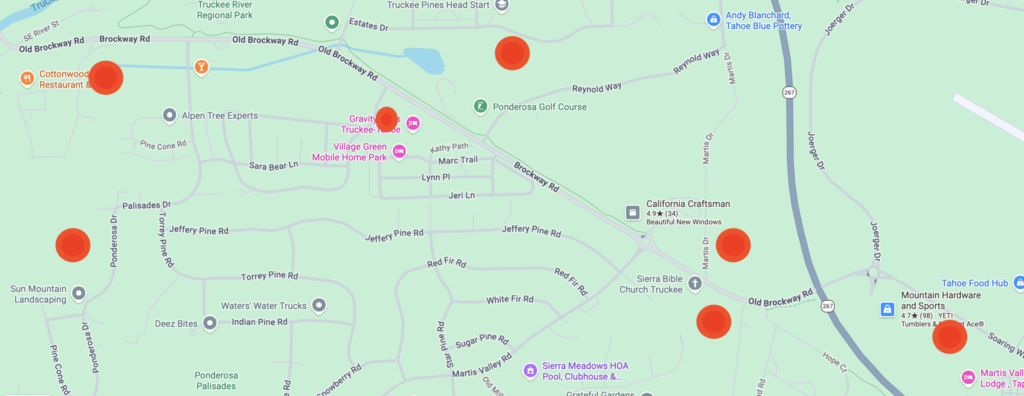
That’s a significant amount of potential development for a single transportation corridor.
The exact number of new housing units is difficult to determine because these projects are all at different stages of planning and development. But one local estimate puts the potential number at more than 500 new housing units over the next decade.
Whether that estimate ultimately proves accurate or not, the larger issue remains: we need to look at the cumulative impact of these projects rather than considering each one in isolation.
IT’S NOT JUST THE HOUSING DEVELOPMENTS
Housing isn’t the only source of additional traffic.
The new Truckee Regional Library is currently in the development phase, with a proposed location at Truckee Regional Park. The current plan would add another 37 parking spaces for library visitors.
Nearby, construction has already begun on a permanent home for the KidZone Museum and activity center. That will also bring additional vehicles to the Brockway Road area.
There are plans to expand the skate park, including parking for another 24 vehicles. And there is currently vacant retail space at The Rock and elsewhere in the area that will eventually be occupied, bringing additional employees, customers, and traffic.
Each individual project may seem manageable.
But together, they add up.
WHERE WILL WE BE IN THE EVENT OF A WILDFIRE?
This may be the most important question of all.
If a wildfire required residents of Sierra Meadows and the surrounding neighborhoods to evacuate, many of us would be trying to reach Brockway Road and then Highway 267 at roughly the same time.
If Brockway Road is already congested under normal circumstances, what happens when hundreds or thousands of additional people need to use it during an emergency?
Increasingly, developers and planners have discussed “sheltering in place” as one component of wildfire preparedness. That may make sense in locations with large, designated areas where people can safely gather, such as Palisades Tahoe or Truckee High School.
But what options are realistically available to residents of our neighborhood?
It’s an uncomfortable question, but one that deserves a serious answer before we add substantially more people and vehicles to a corridor with limited capacity.
EXPANDING BROCKWAY ROAD IS NOT A SIMPLE SOLUTION
So why not simply widen Brockway Road to four lanes?
That’s where the geography of Truckee becomes important.
Highway 89—also known locally as River Road—is currently the only four-lane road within the town of Truckee. Expanding Brockway Road would be an entirely different proposition.
In many places, there simply isn’t enough room.
A major widening project could require the loss of existing businesses, a substantial portion of the ninth hole at Ponderosa Golf Course, and carefully protected wetlands near the Rodeo Grounds. From Palisades Drive toward downtown, the cost and complexity would be enormous.
And even if such an expansion were technically possible, it would take years and require significant public investment.
LET’S LOOK AT THE WHOLE PICTURE
The point isn’t that Truckee shouldn’t grow.
The point is that growth needs to be matched with infrastructure and careful planning.
Brockway Road already carries a tremendous amount of traffic, and that traffic is affected not only by local residents, but by tourism, special events, Highway 267 congestion, businesses, recreational facilities, and seasonal visitors.
Before approving one development after another along the same corridor, we should ask a simple question:
How much more can Brockway Road realistically handle?
We can’t keep adding development along the Brockway Road corridor and assume the transportation impacts will somehow take care of themselves.
Truckee needs to look at the cumulative picture—and make sure our roads, emergency evacuation routes, pedestrian and bicycle infrastructure, and public services can keep pace with the growth we are considering.
Well said. Its not just the roads. It is everything. Music in the park? Too crowded. Truckee Thursdays? Overwhelming. Farmers Market? Nope. Finding a doctor appoint less that 4 months out? Ha ha. It’s time to start saying no to more developments. Kudos to Protect Sierra Meadows.
I sent a link of this post to the Planning Commission and planning staff today. They need to understand that traffic is absolutely an issue.
Every time I cross Brockway road and see how many trucks and cars are at the 4 way traffic lights, I want to move away from Truckee. This is at an an unacceptable level for a small town that boasts pristine air and water quality. Sierra Meadows is already surrounded by large development that was implemented without Truckee Control. Truckee Planing is trying to catch up with Placer county by degrading our areas natural resources as well as the Historical Value of this place. I have spent my life watching this demise of a once beautiful place. Make the ski areas pay for their workers housing and stop this ruin. Sierra Meadows soon Zero Meadows. Environment Impact reports should not be bypassed.